
01
Alumni records
A living record of who left, how to reach them, and what follow-up is supposed to happen next.
Afterflow helps treatment centers and recovery programs run post-discharge, alumni, and step-down retention as an operation, contact, milestones, check-ins, and re-engagement, instead of a forgotten list in a coordinator's inbox.
Afterflow is alumni engagement software a treatment center can actually run: post-discharge contact cadence, milestones, check-ins, and step-down handoffs on one owned record. Follow-up stops depending on whoever remembers a name, and coordinators can see which alumni are due for contact this week and what happened on the last one.
Alumni coordinators, outpatient and residential operators, and clinical-operations leaders who want post-discharge contact to be consistent, visible, and owned.
After discharge, most programs lose the thread. Phone lists go stale. Milestones are remembered by whoever was on shift. Step-down handoffs are a phone call nobody logged. Outreach happens in bursts, then disappears. Families and alumni notice.
The loop below is what Afterflow is built to hold: a record created at discharge, a follow-up cadence tied to the discharge date, logged check-in outcomes, and a clear path back into care or into the alumni community.
Discharge, alumni record, scheduled follow-up cadence, check-in outcomes, and step-down or re-engagement, with team ownership throughout.
Afterflow is the operating layer for this loop. Clinical aftercare planning stays with the clinical team.
A living record of who left, how to reach them, and what follow-up is supposed to happen next.
Check-ins, events, and time-based follow-up are scheduled against the discharge date, not against whoever remembered.
Alumni work has an owner. Notes, attempts, and outcomes stay with the record instead of in a personal text thread.
Choose how long to follow up, how often in the first month, and the interval after that. Every point on the line is a scheduled contact with an owner and a logged outcome, which is the part Afterflow holds.
A timeline from discharge to day 365. 16 touchpoints are scheduled: 5 in the first thirty days, then one every 30 days. Each point is a contact attempt with an owner and an outcome.
| # | Day | Phase |
|---|---|---|
| 1 | 2 | First 30 days |
| 2 | 6 | First 30 days |
| 3 | 11 | First 30 days |
| 4 | 20 | First 30 days |
| 5 | 30 | First 30 days |
| 6 | 60 | Ongoing |
| 7 | 90 | Ongoing |
| 8 | 120 | Ongoing |
| 9 | 150 | Ongoing |
| 10 | 180 | Ongoing |
| 11 | 210 | Ongoing |
| 12 | 240 | Ongoing |
| 13 | 270 | Ongoing |
| 14 | 300 | Ongoing |
| 15 | 330 | Ongoing |
| 16 | 360 | Ongoing |
This draws the cadence you choose, nothing more. Clinical aftercare planning stays with the clinical team; the system's job is to make sure the scheduled contact has an owner and a logged outcome.
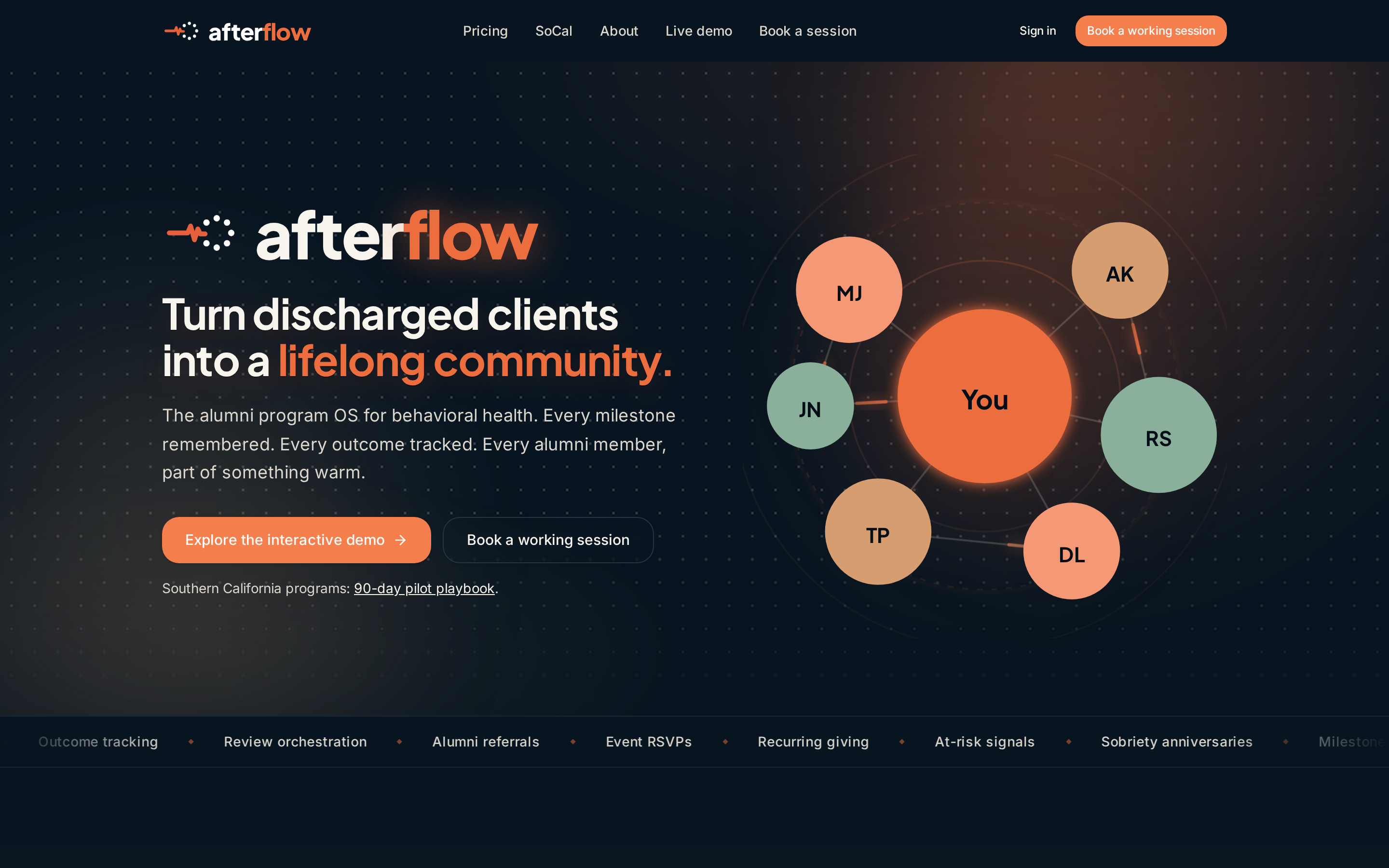
Preview of the Afterflow product site. Interface details and any figures shown there belong to that site’s own demo content.
Afterflow is the post-discharge layer of the Solvhaus operating architecture. It picks up where BedFlow's admissions record ends, so re-engagement and step-down referrals do not start from zero. Clinical aftercare planning stays with the clinical team.
Afterflow does not replace clinical aftercare planning, EHR notes, or a full CRM. It is the operating layer for alumni engagement after discharge.
We start with how alumni work happens today, who owns it, what tools they use, and which follow-ups already fail. Then we configure Afterflow around that reality.
Referral partner CRM for behavioral health, the record Afterflow continues.
Sober living management software for step-down and housing operations.
The operating architecture around the product.
Why alumni contact belongs in the same measurement loop as acquisition.

Tell us how admissions, BD, and occupancy actually run. We will say if this product is the wrong layer, and what the right one is.